Edition 2026.1 · 16 Sections + Expert Playbook + Full Toolkit

Don't clean buildings.
Broker the contracts.

The commercial cleaning industry generates $117 billion a year. You don't need a single mop, a single employee, or a single truck to get paid from it — you need the client relationship and the vendor network. This is the complete system for building that business.

Instant download
One-time payment
$3K-$15K to start — no equipment or crew
Government contracting toolkit included
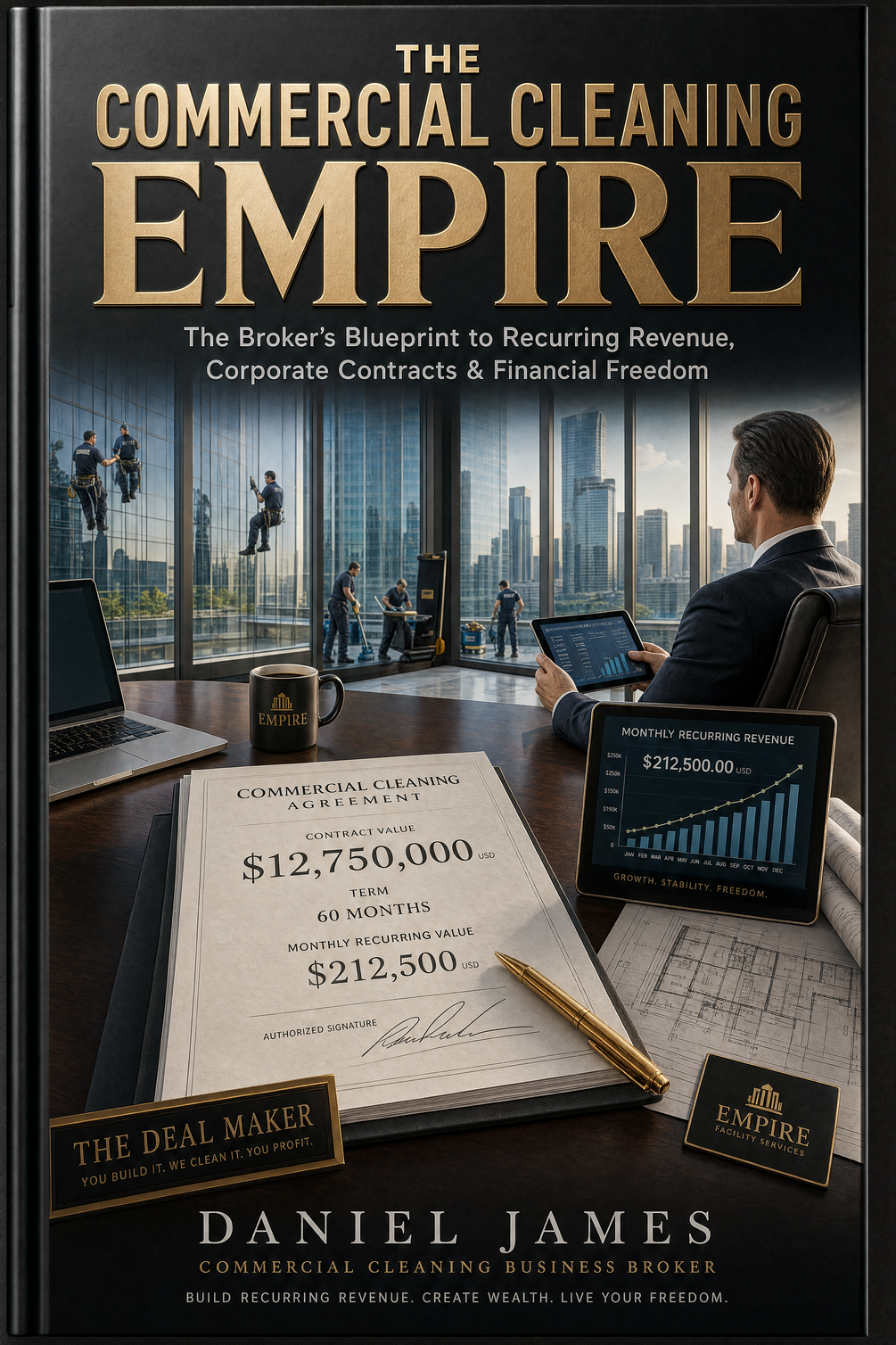
Commercial Cleaning Contracts Broker — official cover
Zero Equipment. Zero Crew.
Recurring Revenue· Vendor Networks· Property Management Portfolios· Government Contracting· Commission & Markup Models· Sub-Broker Networks· Facility Services· Zero Employees Required· Recurring Revenue· Vendor Networks· Property Management Portfolios· Government Contracting· Commission & Markup Models· Sub-Broker Networks· Facility Services· Zero Employees Required
The reality

Most people who try this accidentally start a cleaning company instead.

The $117 billion commercial cleaning industry is fragmented — no company holds more than 5% of it. That's the opportunity. But without a system, new entrants make the same four mistakes that turn a low-overhead brokerage into an accidental, overhead-heavy cleaning company.

Trap 1

Signing contracts before securing vendors

Win a client, then scramble to find a cleaning company to actually do the work — and suddenly you're the one liable for a job with no one qualified to perform it.

Trap 2

No escalation clause, no margin protection

Sign a 24-month contract with no annual price escalation and your vendor's rising labor costs quietly eliminate your margin by year two — while you're locked in.

Trap 3

The vendor discovers your markup

Without a non-solicitation clause and a subcontracting structure that protects your position, the cleaning company you introduced to a client can simply cut you out.

Trap 4

One client is 60% of your revenue

A single large property management portfolio feels like a win — until they renegotiate your fee or leave, and your entire income disappears overnight.

Every one of these traps is preventable. They're all in this guide — named, documented, and paired with the exact contract language and systems you use instead.

The scope

A massive, fragmented, wide-open market.

0
US Commercial Cleaning Market

Growing ~3.8% annually toward a projected $145B by 2029. 900,000+ businesses compete for it — the top 10 companies hold under 25% combined.

0
Typical Startup Capital (Max)

A real cleaning company with equipment, vehicles, and payroll costs $25,000-$150,000+ to launch. This model needs a laptop, a phone, and insurance.

0
Core Curriculum + Expert Playbook

From your first cold call through government contracting, sub-broker networks, and a documented exit at 36-60x monthly recurring revenue.

The model

Why brokering beats owning a cleaning company.

A cleaning company owner carries employees, workers' comp, equipment, and 200-400% annual staff turnover. A broker carries a laptop, a phone, and a vendor network. Same industry, radically different risk profile.

Startup Capital
$3K–$15K

vs. $25,000–$150,000+ to launch an actual cleaning company with equipment, vehicles, and a trained crew.

Time to First Revenue
30–90 Days

No hiring, no equipment delivery lead time, no crew training cycle standing between you and your first signed contract.

What You Never Deal With
Employees

No payroll, no workers' comp claims, no 200-400% annual staff turnover — the single biggest operational headache in the entire cleaning industry.

How you get paid

Three revenue models. Pick one, then layer in the rest.

Commission Model

Introduce the client, the cleaning company bills directly, you collect 10-25% of contract value monthly. Zero billing risk — the easiest starting point.

Markup Model

You're the vendor of record. You bill the client at retail, pay your subcontractor at wholesale, keep the 20-35% spread. Full control over pricing and the relationship.

Management Fee Model

A flat $300-$2,000/month per location on top of the cleaning cost — ideal for managing large property management portfolios with many buildings.

Inside the guide

Three real paths. Three different plays.

The manual closes with documented composite case studies drawn from real brokerage operating patterns — each showing a different lever pulled to scale past a solo operation.

The Property Manager Pivot

Marcus — Dallas-Fort Worth

An 11-year commercial real estate leasing agent with 40+ property manager relationships but zero cleaning experience. Started with $6,200 in capital, calling his existing network instead of cold-calling strangers.

Month 3 MRR$1,950
Month 14 MRR$28,400
Key win27-property PMC deal
Annual run rate$340,800

One BOMA chapter lunch produced 27 simultaneous contracts from a single relationship.

The Government Contracting Specialist

Denise — Federal Focus

An 8-year federal contracts administrator with zero cleaning or client relationships, but deep procurement knowledge. Spent her first 90 days entirely on SAM.gov registration and WOSB certification before her first sales call.

Month 4First county contract
Month 18 MRR$31,800
Active contracts11 (fed/state/county)
Teaming agreements4 prime contractors

Teaming with an 8(a)-certified vendor unlocked an $18,000/month federal contract she couldn't have won alone.

The Multi-Market Sub-Broker Network

Kevin — 6 Metro Markets

A former B2B software sales rep who hit a solo ceiling at 38 contracts, then documented his sales process well enough to teach it — and started recruiting sub-brokers on a 45/55 revenue split.

Month 12 (solo)$21,400 MRR
Month 36 network MRR$79,500 (136 contracts)
Kevin's monthly income$49,415
Est. brokerage valuation$1.8M–$2.2M

5 sub-brokers across mid-sized markets, each running the same documented playbook.

What's inside

Every section is operational. Nothing is filler.

16 sections. An Expert-Only Playbook. Hidden market opportunities. A complete toolkit built from scripts, contracts, and calculators actual brokers use.

12-Section Core Curriculum

Industry overview, the brokerage model, business formation, finding clients, finding vendors, professional sales, pricing, government contracting, operations, legal, technology, and scaling.

Competitive Intelligence Toolkit

FOIA request templates for competitor pricing, bid tabulation analysis, building permit tracking, and property management software intelligence — find contracts before they're even posted.

Full Vendor Qualification System

10-point qualification framework, insurance verification protocol, background-check requirements, and a monthly vendor scorecard so a bad subcontractor never costs you a client.

Government Contracting Toolkit

SAM.gov registration walkthrough, Sources Sought response templates, FOIA request letters, bid calendar tracker, and the SBA 8(a) sub-contracting strategy.

Sub-Broker Network System

The complete recruitment pitch, 40-hour training curriculum, and revenue-share agreement template used to scale one operator into a 6-market, $79,500 MRR network.

Sales Scripts & Email Sequences

Cold call scripts for property managers, medical offices, and warehouses; a full 6-email cold outreach sequence; LinkedIn outreach cadence; and objection-handling responses for every common pushback.

Legal & Contract Templates

Client service agreement, subcontractor agreement with non-solicitation protection, worker classification analysis by state, and CPI/labor-index escalation clause language that actually survives client pushback.

Pricing & Profitability Model

Square-foot pricing benchmarks by facility type, production-rate labor calculators, margin guidelines by contract size, and a full annual brokerage P&L model with tax reserve planning.

25 Myths vs. Reality + 25-Question FAQ

The 25 most damaging misconceptions in the industry, corrected one by one, plus a full FAQ library covering starting, sales, pricing, vendor management, legal, and scaling.

Be honest with yourself.

This is for you if
  • You want recurring revenue without owning equipment, hiring crews, or carrying workers' comp
  • You have (or can build) relationships with property managers, facility managers, or business owners
  • You're comfortable with cold outreach, walkthroughs, and professional sales conversations
  • You want a business you can eventually scale through sub-brokers or sell as a contract portfolio
  • You're willing to do real vendor due diligence — not just introduce the first cleaner you find
This isn't for you if
  • You actually want to run a cleaning company with your own crew (see our companion operator guide instead)
  • You're looking for a fully passive, zero-effort income stream
  • You won't invest in proper insurance, contracts, or vendor qualification
  • You expect your first cold call to close — this is a 30-90 day sales cycle business
  • You think signing any vendor without a subcontractor agreement is fine
Get the guide

One payment. Instant access.

No subscription. No upsells. No drip-fed modules. Pay once. Get everything. Start executing today.

Commercial Cleaning Contracts Broker
The Complete Professional Guide
Edition 2026.1 · 16 Sections + Expert Playbook
One instant download — curriculum + toolkit + FAQ library, all in one file
What it would cost elsewhere:
$997+
$29
one-time · instant access
What you get
12-section core curriculum
Competitive intelligence & FOIA toolkit
Government contracting toolkit
Sub-broker recruitment & training system
Cold call scripts & email sequences
Client & subcontractor agreement templates
Pricing & annual P&L model
Vendor qualification & scorecard system
3 documented case studies
25 myths vs. reality
25-question FAQ library
7 quick-reference tables
Buy Now — $29

Secure checkout · Card, Apple Pay, Google Pay · Instant delivery

A single Class A office contract at $8,000/month, brokered at a 22% margin, pays for this guide in under 3 hours of one month's income. Everything after that is profit on the system.
Frequently asked

Common questions

Do I need any cleaning experience? +

No. You are not the one cleaning. Your job is finding clients, qualifying vendors, and managing the relationship — the guide's case studies feature a real estate agent and a federal contracts administrator, neither with prior cleaning industry experience, building six- and seven-figure brokerages.

How is this different from actually starting a cleaning company? +

A cleaning company hires crews, buys equipment, carries workers' comp, and deals with 200-400% annual staff turnover. A broker introduces clients to vendors who already do all of that, and earns a commission or markup. Same industry, dramatically different capital requirement and operational complexity.

What format does the guide come in? +

The entire curriculum, expert playbook, toolkit, and reference tables are delivered as a single comprehensive .docx document — easy to read on any device and to reference during client calls and contract negotiations.

Can I really win government cleaning contracts as a broker? +

Yes — covered in full in Section 8 and the Expert Playbook. Local government contracts (city, county, school district) are often more accessible than large commercial bids because many qualified vendors never pursue the paperwork. The guide includes SAM.gov registration steps, FOIA templates for competitor pricing, and a teaming strategy for accessing federal set-aside contracts.

How fast can I land my first contract? +

Following the 45-day action plan in the guide, most readers can realistically close their first contract within 45-75 days of starting — the case studies show first contracts as early as Month 3 and as late as Month 4-6 for government-focused strategies.

Why $29 and not $997 or more? +

Business consultants charge thousands for a comparable system. This guide gives you the entire operating playbook — sales scripts, contracts, pricing models, and a government contracting toolkit — for less than the cost of a single hour of consulting.

Will it be updated? +

Yes. This is Edition 2026.1. As procurement rules, worker classification law, and platform tools change, updated editions will be pushed at no extra cost.

Stop thinking about the deal.
Start brokering it.

Every week you spend deciding whether to start, another broker in your market is calling the same property managers, signing the same portfolios, and building the recurring revenue base that should have been yours.

Get Instant Access — $29

Instant download · One-time payment · All content included